Development Boards – Platforms for Designing and Implementing IoT, AI, and Embedded Systems Solutions
Development boards (also known as development kits or developer boards) are ready-made hardware platforms on which IT and R&D teams build, test, and launch their own solutions. Instead of designing electronics from scratch, a company receives a working kit with a processor, memory, interfaces, and software support. This shortens the time from idea to working prototype, and in many cases, also to production deployment.
In this category, you will find platforms for two types of tasks: compact mini-servers for operation in a corporate network and computing modules for artificial intelligence running directly on the device (edge AI).
How Companies Use Development Boards
In a business environment, they are used as the foundation for specialised devices, automation systems, and applications that process data on-site. The most common applications include:
- Prototyping devices – quickly validating a product concept before investing in the design of custom electronics.
- Edge computing – analysing data where it is generated, e.g., on the production line or in a warehouse, without sending everything to the cloud.
- Vision systems and AI – object recognition, quality control, counting people, or reading license plates.
- IoT and industrial automation – collecting data from sensors, controlling machines, communication gateways.
- Small servers and network services – router, VPN, application container, file server in a branch or testing laboratory.
Types of Development Boards
Mini-servers on a Board
These are compact platforms with an ARM processor, several Ethernet ports, data storage connectors, and a ready-to-use operating system. They serve as a cheap, energy-efficient server for network tasks and services running in containers. An example is the QNAP QBoat Sunny – a mini-server that can be used as a platform for testing applications, a local service server, or a component of infrastructure in a small branch.
Computing Modules for AI (SoM)
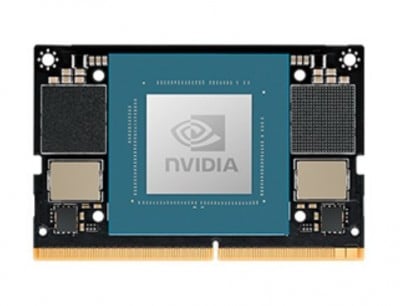
SoM is a module that contains a processor, graphics chip, and memory in one small package. It is mounted on a carrier board that provides connectors and power. This solution allows you to design your own device while retaining an efficient, proven computing core. Available in the offering is the NVIDIA Jetson Orin Nano 8 GB with an ARM Cortex-A78AE processor and a graphics chip based on NVIDIA Ampere architecture, intended for running artificial intelligence models on edge devices.
How to Choose a Development Board – Key Parameters
Processor and Architecture
Most development boards use ARM processors, which combine decent performance with low power consumption. For AI tasks, an accelerator – GPU or NPU unit – and its performance measured in TOPS (trillions of operations per second) are also crucial.
RAM and Storage
The amount of RAM determines how large AI models and how many applications can run simultaneously. It is also worth checking the type of storage: eMMC, microSD, or M.2 drive. The M.2 storage provides higher performance and durability under intensive write conditions.
Interfaces and Connectivity
The number and type of ports determine what the board will connect to. Pay attention to Ethernet ports (and their speed), USB, PCIe, and interfaces for sensors and external devices: GPIO, I2C, SPI, UART. In vision systems, the MIPI CSI camera connector is essential.
Power Supply and Operating Conditions
Low power consumption facilitates installation in enclosures without active cooling and in locations with limited power supply. For deployments outside of data centres, check the operating temperature range and heat dissipation method.
Software and Product Lifecycle
A development board is worth as much as the ecosystem that supports it. Important factors include: supported operating system, availability of libraries and tools, security updates, and declared availability period. For mass-produced devices, a long module lifecycle protects against the need to redesign the product.
Purchasing Development Boards at Senetic
Senetic advisors will help you select a platform for your project, check compatibility with accessories, and determine availability. Before purchasing, it is advisable to define the intended use, required interfaces, and operating conditions of the device – this will facilitate the choice between a mini-server and a computing module for AI.
FAQ – Frequently Asked Questions
What is a development board?
It is a ready-made hardware platform with a processor, memory, and interfaces, used for creating, testing, and implementing your own solutions – from device prototypes to AI and IoT systems.
What is the difference between a SoM module and a development board?
A SoM module contains only the computing core: processor, GPU, and memory. It requires a carrier board with connectors and power to operate. A complete development board has these elements on one board and is ready to work immediately.
What is the NVIDIA Jetson Orin Nano used for?
It is a module for running artificial intelligence models on edge devices, e.g., in vision systems, robotics, quality control, or image analysis from cameras, without sending data to the cloud.
Can a development board function as a server?
Yes. Mini-servers on a board, such as the QNAP QBoat Sunny, are suitable for light network services, application containers, and testing environments. However, they will not replace a server under heavy load.
What operating system runs on development boards?
Most commonly, it is a Linux distribution provided or supported by the manufacturer. NVIDIA Jetson modules use the JetPack package, while QNAP platforms use the manufacturer's own system.
Are development boards suitable for production deployments?
Yes, provided that you choose a platform with a long availability cycle, support for updates, and an appropriate operating temperature range. SoM modules are designed specifically for mass-produced devices.